Life Cycle Assessment (LCA)
To assess the environmental performance of its products, identify the most impactful life cycle stages, and improve.
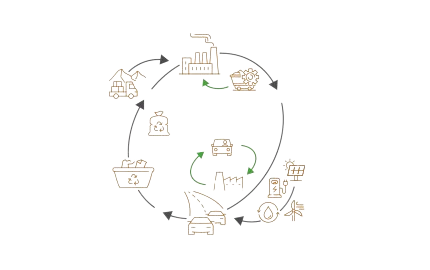
Life Cycle Assessment, also called Life Cycle Analysis in Italian, is an international, standardised methodology for assessing the environmental impact of products and services during their entire life cycle (from cradle to grave).
LCA is standardised by ISO 14040 and 14044, which define the guidelines for the application of the methodology, dividing it into 4 stages:
- Definition of the objective and scope.
- Inventory analysis.
- Analysis of environmental impacts.
- Interpretation of results.
Life Cycle Assessment makes it possible to assess the impact of a product or service according to the most common environmental indicators, including for example:
- Global Warming Potential
- Ozone Layer Degradation
- Eutrophication
- Consumption of water and resources
- Waste production.
By means of an LCA study, a company can assess the environmental performance of its products, identifying the most impactful life cycle phases on which to intervene in order to effectively improve without shifting problems from one sector, industry or phase to another. In addition, an LCA study can be used as a methodological basis for various environmental certifications that allow the communication of impacts to end customers, as well as allowing the quantification of impacts useful to implement mitigation and compensation projects.
Greenwich has been carrying out environmental impact assessments according to the LCA methodology for its clients for over 12 years.
Product certifications based on Life Cycle Assessment studies:
Environmental Product Declaration (EPD)
Product Environmental Profile (PEP)
Carbon Footprint (CF)